Although I am not one to share personal stories, let alone expose myself publicly in a state of vulnerability, circumstances are nevertheless compelling me, against my will, to
speak out.
I am now, at the age of 58, suffering from pancreatic cancer with metastases in my lungs, against which weekly chemotherapy merely delays a life expectancy measured in months. Like many of the patients I come into contact with every day and who, like me, are fighting tooth and nail to stay alive, I watch in silence, astonished and even deeply shocked, as debates concerning me — concerning us, the patients — take place so far removed from where we are, in another world.
Thirty years ago, when I was just 27, my life was turned upside down by a diagnosis of acute leukemia (LAM3), which left me with little chance of survival. At a time when pain was still largely overlooked in medical care, I went through terrible periods that left me completely disoriented and made me want to end it all as quickly as possible. I wanted to die. The medical staff and my family fought alongside me and for me so that I could get through those moments of distress. And just as I was beginning to get back on my feet, after four years of complete remission, I faced the fear of a relapse; my younger brother donated his bone marrow so that I might live. I owe him 30 years of life, an exciting life, which I still consider today to be a gift.
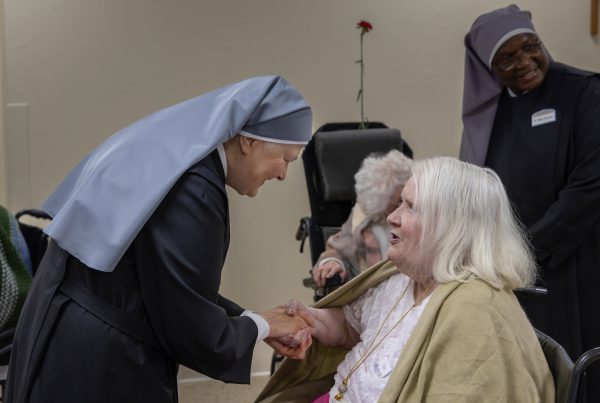
This gift inspired in me a desire to devote my own life to serving others. I did so as a religious, a Little Sister of the Poor, caring for the elderly in care homes — which we prefer to call ‘My Home’, because for us they are homes of life where we share our poverty and our riches, rather than homes of ‘dependence’ and ‘end of life’. In this context, I had the grace to experience this companionship right up to the very end of life, with so many people whose faces and life stories remain so vivid in my memory.
I have so much to say about those intense moments at the end of a life, when everything comes together, when relationships deepen, when reconciliation finally becomes possible — provided that pain, and more broadly, suffering, are heard, taken into account, and managed as closely and collaboratively as possible. I have so much to say about my experience of palliative care and the radical difference it makes to this support, accepting reality, rejecting the unreasonable persistence of curative treatments when they no longer make sense, taking into account the person in all their dimensions, in their history and their relationships.
Today, finding myself facing this same end of life, I was able to draw peace from that experience: death, though it remains a tragedy, can be experienced with support and surrounded by loved ones, as the final act of a life well-lived, provided we allow that life to have its final say — a moment that will always surprise us with its intensity.
So I am deeply shocked, on reading the law in its current form, to discover that I am now eligible for assisted suicide or euthanasia. Moreover, seeing the inconsistency to which the palliative care bill has been reduced and the open fast track to facilitate ending one’s life, the law instills in me a profound sense of unease, the loss of a sense of security that rested on a pact of trust — even a sense of betrayal — and makes me angry.
Will this support from loved ones and medical staff, which helps me overcome bouts of depression in this deeply ambivalent state at the end of life, become an “offence of obstruction” punishable by law? Will this fraternal struggle to help me carry on living immediately come under suspicion?
What is more, a new, more radical burden is being added to my situation, its poison seeping into me: through the law, society itself is showing me the way out. Surely I am a burden to it; I cost the National Health Service a fortune, and I would be better off ending it all.
Now, let’s be clear, behind this bill, even if for some there is the personal emotion stemming from a negative experience with a loved one — but should emotion dictate the law? — there is also, for many, the detached ideology of autonomy and freedom that only healthy people can claim, not to mention the far less honorable calculations stemming from the social security deficit in the face of the specter of an aging population.
What weight do my words carry in the face of all this? And yet, if I have dared to speak out, it is to give a voice to those who, like me, are ill and bear the burden and stigma of these debates. Also to shine a light on those caregivers who, aware of the ambiguity and fragility of the end of life — where the desire to end it all is above all a cry for help — so humanely draw us towards life, yet risk being suspected themselves. In short, all those who are most directly affected by the law and who, curiously, are so absent from this debate.
Taking a life will never be the answer to suffering. On the contrary, for those who are frail and dependent on those around them — for whom their whole life depends on their relationships — there is the immense power of a loving gaze and human solidarity that gives life. o
— Sr Bénédicte Marie de la Croix, lsp